
My cloth diapering journey
We’re expecting a baby. That’s when my cloth diapering journey started.
As the due date was approaching, I of course started preparing all the baby essentials, and diapers are an inseparable part of that. I had no experience yet, so I bought several different brands. Loaded down with packages, I headed home, only to realize that I didn’t even know where to store them. Either I’d have packs of diapers lying around somewhere, or I’d constantly have to run to the store. And what about the used diapers, which don’t smell very nice either? Well, I figured I’d just take them with me on my next trip to buy another pack. But what about all the waste that would end up in nature? I started asking myself if there might be another way. The answer was clear: once I got a bit used to life with the baby, I would start using cloth diapers.
Determined, I shared my plan with a few friends who already had children. But every time I got the same response: not to be silly, that I’d be grateful for disposable diapers, because even without washing cloth ones, I’d already have more than enough to do with the baby. So I gave up on the plan for the time being, telling myself I’d see later.
How I started…
Our beautiful baby girl was born. A few hours after delivery, they brought her back to me, telling me to put her to my breast and then change her diaper. I was so afraid to even move that tiny little bundle that the first few diaper changes were slightly stressful for me. So I didn’t even think about cloth diapers—it had to be even harder.
After we came home from the hospital, I started producing a lot of milk—really a lot. It was everywhere. Of course, I had disposable nursing pads ready until my lactation settled. Assuming it would happen soon, I kept buying more and more packs, but nothing changed. Then I came across reusable nursing pads online and wondered whether it was still worth buying them. It definitely was—I’ve been using them for half a year now, and sometimes I’m really glad I have them.
At least there was one less bag of waste every few days, but we were still constantly taking diapers out to the trash. Well, I thought, at least I’ll burn off the extra weight I gained after giving birth. But that wasn’t what bothered me. With every bag full of diapers, I kept thinking about how it would sit somewhere in a landfill for another 200–400 years. You could say that the diapering period only lasts about two years, so it doesn’t matter much—but that’s not really true. A single child can produce up to one ton of diaper waste per year, which is twice as much as the average citizen of Slovakia. Their production also consumes large amounts of resources such as wood, water, and oil. Even transporting them is environmentally demanding.
So I returned to my original plan and started looking into different kinds of cloth diapers.”
Why I chose Bobánka?
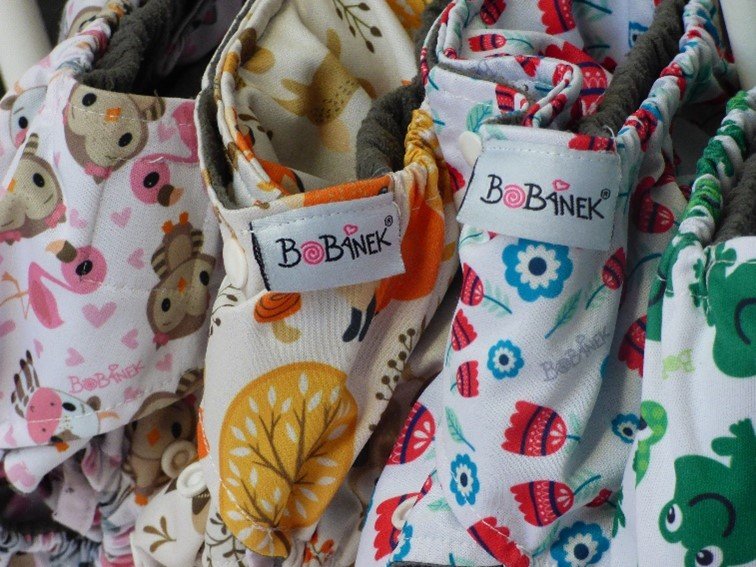
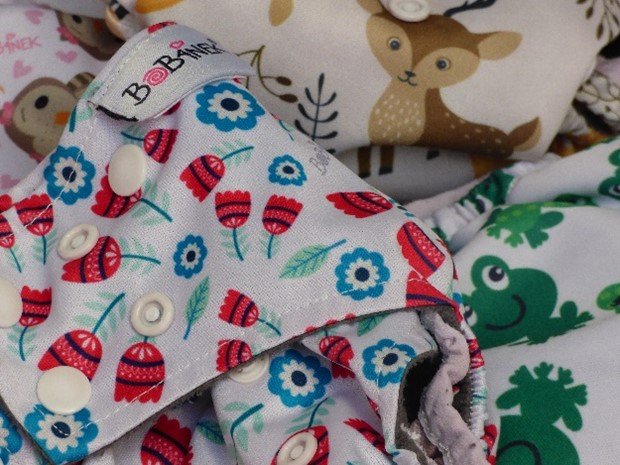
My mom pulled out the classic white cloth squares from the basement and started explaining how it used to be done. I looked at her in horror. After using disposable diapers, it was almost unimaginable for me to deal with that much work. So I started searching online for different brands. Bobánka caught my attention with its beautiful designs. It was also important to me that most of the diapers have a grey inner layer, so I don’t have to worry about stains. The AIO system looked quite simple—no stuffing or adjusting anything. Another advantage was the reasonable price. I decided to go all in, and to make sure I wouldn’t back out, I bought a complete set for full-time cloth diapering.
When it arrived, I was thrilled. My daughter weighed a little over 4 kilos, and I still had several packs of disposable diapers left, so I planned to start once she reached 5 kilos and I used them up. During that time, I felt a bit nervous. Would it be very demanding? Would I have any free time? Could it really be as simple as using disposables? But my worries turned out to be unnecessary—after just a few changes, it felt exactly the same as before. I got a sealed bin for storing used diapers, added a few drops of essential oil to the lid, and there was even a pleasant scent around the changing table.
And the dreaded diaper laundry? It actually took me even less time than taking out the trash with disposable diapers. I simply put the used diaper into the bin right next to the changing table. Any solid waste is caught by a liner, which is 100% biodegradable, so I can flush it down the toilet or put it in the compost. In the evening, I put the diapers into the washing machine—first a rinse cycle, then I wash them at 60 °C. After washing, I hang them up, and by morning most of them are dry (I use different types, so they dry at different speeds), and I don’t have to worry about anything for the rest of the day. It’s that simple—all it took was not being afraid to try.
From a health perspective
Reasons why disposable diapers are a NO!!
Through my interest in cloth diapers, I also realized that disposable ones are not only a burden on the environment but aren’t the best choice from a health perspective either. The absorbent core is made from pulp, which comes from cellulose and is bleached using chlorine dioxide. This method is more environmentally friendly compared to the older process using chlorine. It significantly reduces the amount of chlorine compounds released into the environment, thereby lowering the formation of dioxins, which can affect the reproductive and immune systems. They are toxic to aquatic organisms, accumulate in their bodies—and thus throughout the food chain—and may even be carcinogenic. However, the pulp is not completely chlorine-free.
Another harmful substance is tributyl tin, which is toxic to aquatic life and damages the immune system. While diapers contain only a small amount, sensitive baby skin is exposed to it almost continuously for about two years, so it’s certainly not negligible.
There’s also polypropylene and polyethylene—plastics made from petroleum—which make the diaper leak-proof but at the same time prevent air circulation. This causes high humidity inside the diaper, which changes the skin’s pH and encourages the growth of bacteria and fungi. This can lead to diaper rash and various dermatitis conditions. From this perspective too, I’m glad I’m not exposing my baby to these risks.
Something for joy
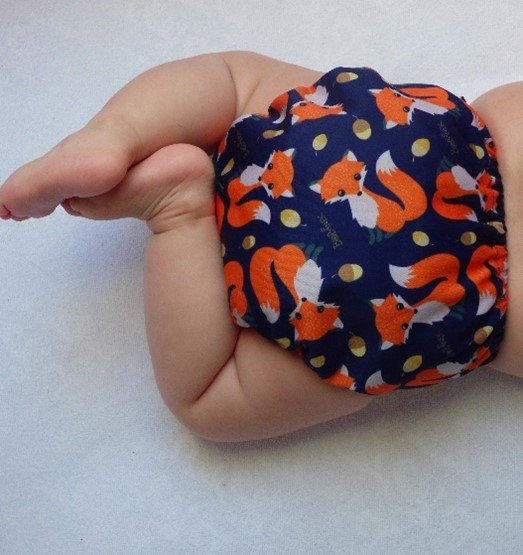
In conclusion, I’d like to share the joys I’ve found in cloth diapering. I sometimes think, ‘How is it that diapers are the reason for my happiness?’—but that’s just motherhood for you. Every little pleasure counts. Not only do I no longer try to delay changing my baby for even a minute just to stretch a disposable diaper, I now change her as soon as she needs it, keeping her comfortable and dry. I can choose from so many cute patterns (I even have favorites that I love the most). I don’t have extra expenses for diapers every month. But most importantly, I feel proud knowing I’m not burdening the planet and that I’m doing this for my daughter’s health. So every time I get the chance to say that I use cloth diapers, I do so with pride.